
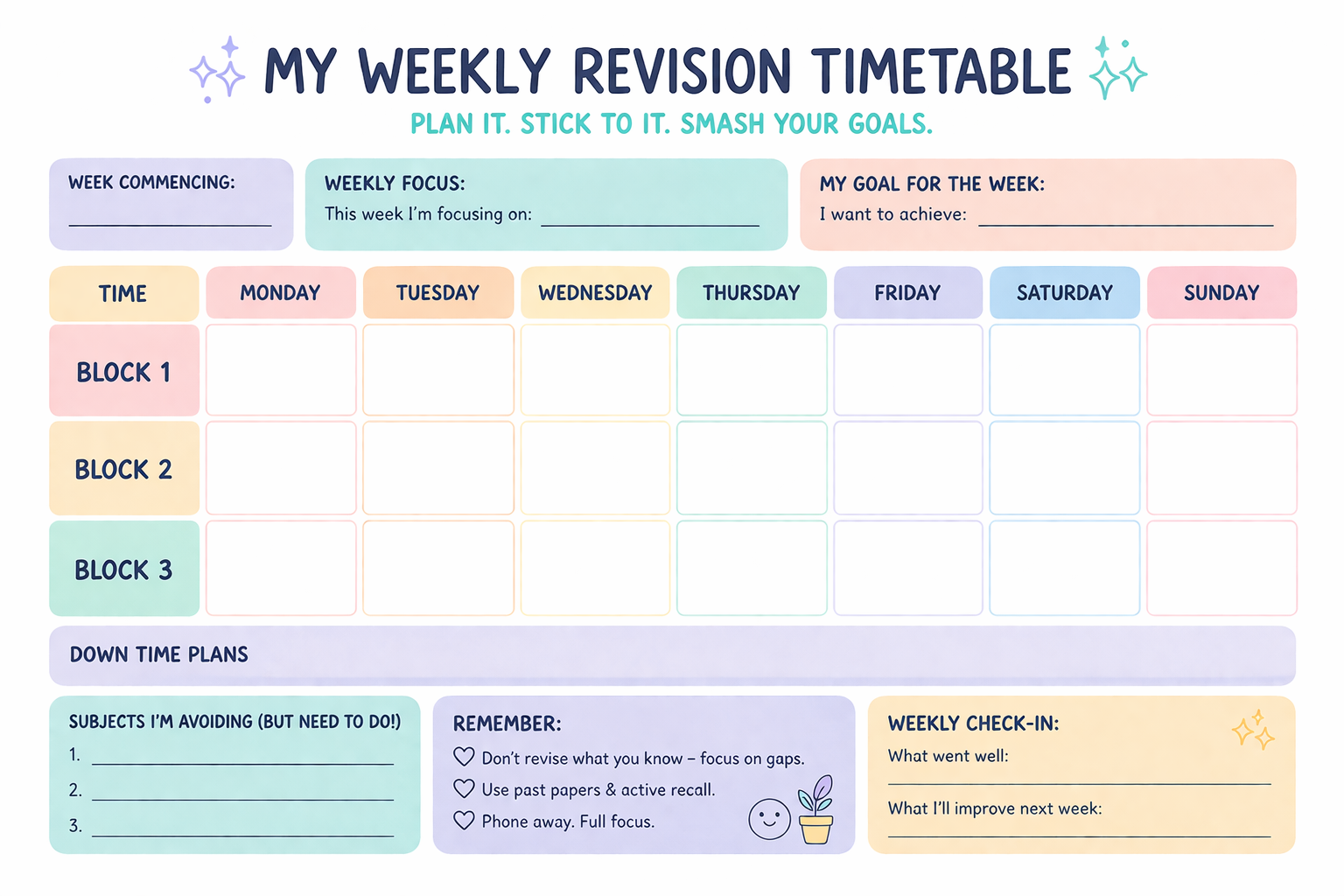
Easter GCSE revision timetable ‘s usually do not look like the perfect colour-coded timetable you see online.
If we are being completely honest it looks like lie-ins, doom scrolling on phones first thing in the morning, and then a bit of last-minute panic in the evening before a late night session on a games console.
As a teacher, I see the same patterns every year. It’s not a lack of ability. It’s poor structure.
So if you’re trying to support your teenager (or you are one), here’s what a realistic GCSE revision timetable should actually look like.
What a GCSE Revision Timetable Should Actually Look Like
A good timetable isn’t about working all day.
It’s about working properly.
You don’t need 10–12 hours. You need around 6 focused hours a day during the holidays.
The issue is how that time gets used.
Most students:
- Sleep in and lose half the day
- Go straight on their phone when they wake up
- Revise easier topics instead of harder ones
- Leave subjects like science until last because the exam is later
That’s where panic sets in.
A lot of students prioritise based on exam order:
“English is first, I’ll revise that now and do science later.”
But by the time “later” comes, they’re tired and overwhelmed.
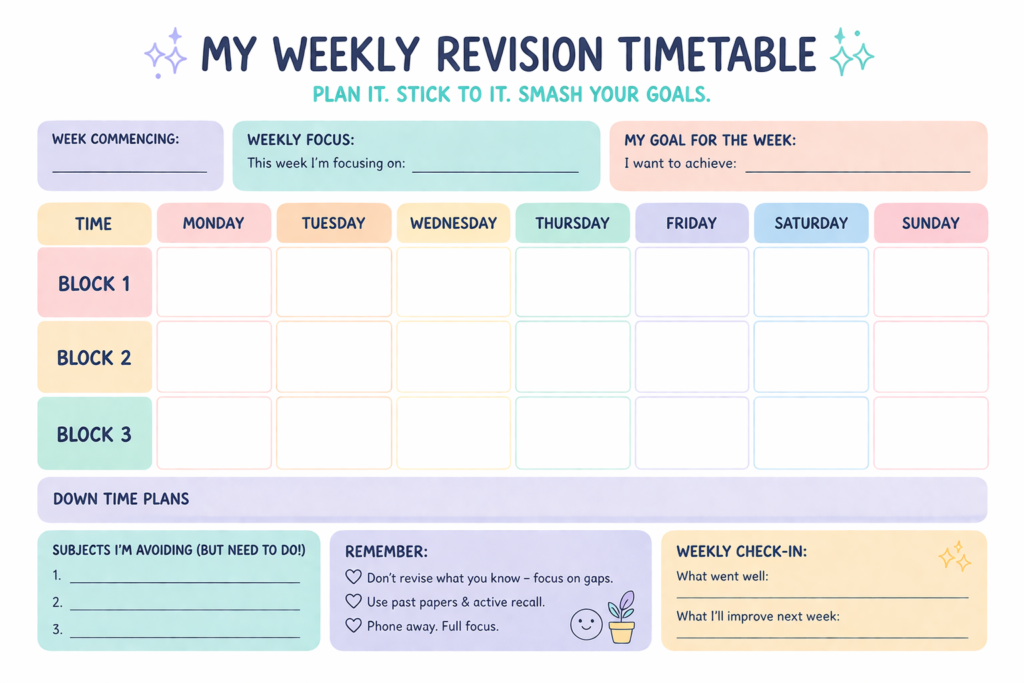

A strong revision timetable spreads subjects out and focuses on what they don’t know.
Start the Day Properly (This Matters More Than You Think)
An effective revision day starts the moment you wake up.
If the first thing you do is scroll your phone, you’ve already lost momentum.
A better routine looks like this:
- Get up at a normal time
- Have a proper breakfast
- Get showered and ready
- Do something small first (walk, errands, fresh air)
Then sit down and start.
You don’t need to start at 7am. Even 10am is fine.
But start the day with purpose.
The Best GCSE Revision Timetable Method (Pomodoro)
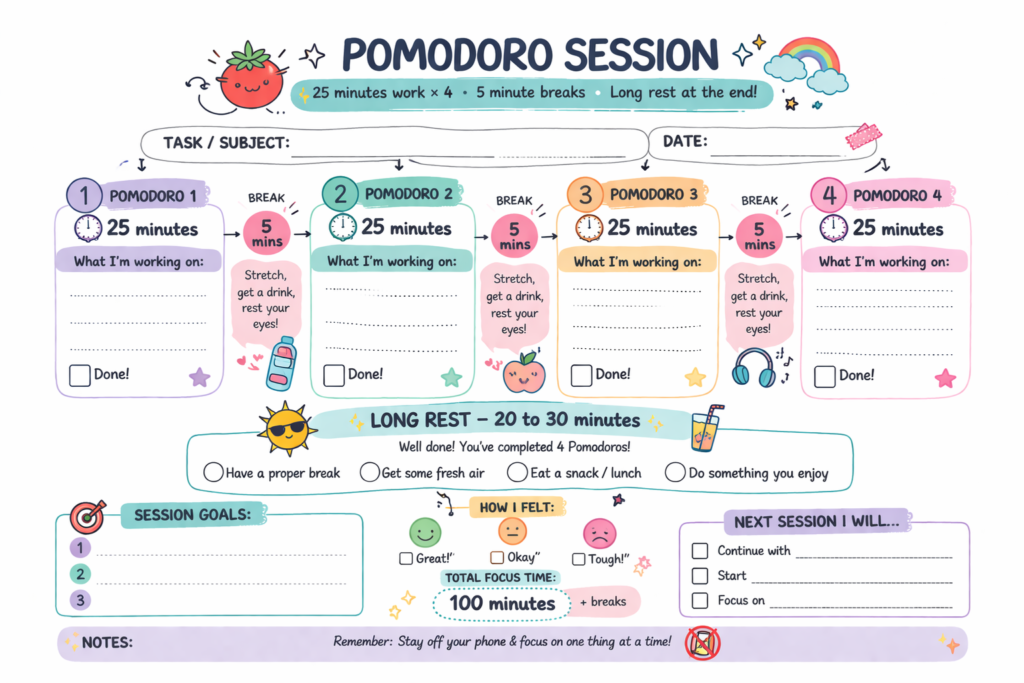

The easiest way to structure your day is the Pomodoro technique:
25 minutes of focused work 5 minute break Repeat 4 times: Then take a longer break
That gives you a solid 2-hour block.
Do this 2–3 times across the day and you’ve got your 6 hours.
Example GCSE Revision Timetable (That Feels Realistic)
Here’s what this could actually look like:
Morning
10:00–12:00 Revision block 1 (Pomodoro x4)
12:00–1:00 Lunch / break
Afternoon
Go out, meet friends, go to the park, cinema, football
Late Afternoon
3:00–5:00 Revision block 2
Evening
Dinner, relax
That might be enough.
Or you can add a third block if needed.
It doesn’t have to be rigid. If you’ve got a planned family day out to a theme park or the beach then go for it. There’s two whole weeks for the Easter break plus a teacher training day or two so there’s plenty of time for both downtime and hard work.
Plan Your Revision (Don’t Waste the 25 Minutes)
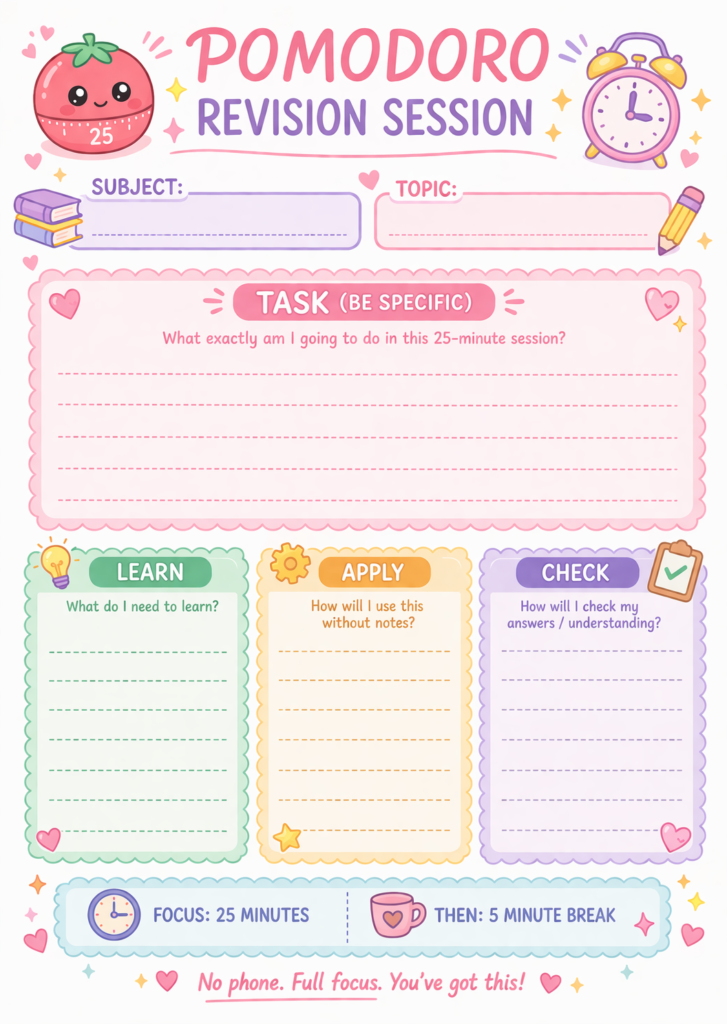

One of the biggest time-wasters is sitting down and not knowing what to do.
You cannot spend half your session:
finding your pen choosing a topic figuring it out as you go
Instead:
Plan your revision the night before
Be specific
For example:
- Create flashcards for biology: cell structure
- Answer one English question and plan paragraph points
- Label 3 diagrams for science topics you don’t know
You could even use one 25-minute block just to plan the next day.
Stop Revising What You Already Know

This is one of the biggest mistakes I see.
Students revise what feels comfortable.
They copy notes, rewrite pages and highlight things they already understand.
It feels productive. It isn’t.
A better approach. Allocate some time to reviewing each subject and some specifics.
Print out a past paper (make sure you’ve got the correct exam board) and go through each question
Highlight what you don’t know
Ignore what you do know
You don’t need to practise what you’ve already mastered.
That’s not where the marks are.
What I See in the Classroom (And Why It Matters)
I teach across KS3 and GCSE, and I also have a Year 12 form. I see the full picture.
At the start of this year, I gave my Year 11 class a practice paper.
They looked at it in absolute horror.
They hadn’t seen a paper before. They didn’t understand how the questions worked.
In my subject (Hospitality and Catering), questions can be worth a lot of marks, but students often get the approach wrong.
They think they need to list loads of points.
They don’t.
What they actually need to do is expand their answers.
We use a simple structure:
Point
Evidence
Explain
So instead of listing six things, they might write three strong points and explain them properly.
One exercise which can be very useful is comparing model answers against a mark scheme. Most exam boards will have resources like this so you can look at a variety of different responses worth low, medium and high marks and compare the differences. This kind of approach really helps to understand the key features a good response may needs
This knowledge only comes from practising exam questions, not just reading notes. The idea is that you want pupils to open an exam paper on the day of their exam and feel confident that they know exactly what to do.
The Truth About Screen Time
Let’s be honest.
A lot of “breaks” are actually:
TikTok scrolling gaming late into the night
That’s not rest. That’s just draining energy.
I had my form check their screen time recently and it was a genuine eye-opener. It’s quite easy to do this by checking settings.
If you change one thing, make it this:
Be aware of screen time
Keep phones away during revision
Make breaks intentional
How Parents Can Actually Help (Without Getting It Wrong)
This is where it gets tricky.
Most parents are trying to find the balance between being too strict and being too relaxed.
You think:
“They’ve worked hard all year, they deserve a break.”
But a few days off quickly turn into a week, and then it’s very hard to get back into a routine.
Easter is long. You need rhythm.
Because realistically, this is the end of 11 years of school.
It would be a shame to fumble it now.
Don’t Rely on Teenagers to Tell You Everything
Teenagers are not great at explaining:
Do they know the exam boards specifications and exactly what they actually need to revise?
Some will be organised. Many won’t.
It’s not difficult for a parent to:
Review the school website, check the exam boards, look at the specification and understand what topics are needed
You don’t need to teach it. Just support it.
Make Revision More Active (And Less Lonely)
Revision on your own can feel isolating.
There are simple ways to make it more engaging:
- Sit and quiz them using flashcards
- Let them talk through topics
- Write while they explain
One strategy I use in class is revision clocks:
Pick 12 topics
Set a timer for 5 minutes
The student talks through everything they know
They can write it down or you can’t
You don’t need to understand it. Just capture it.
Then check:
What did we miss?
Where are the gaps?
That becomes the next revision task.
You can turn this into a 25-minute session:
5 minutes brain dump / 5 minutes review / 15 minutes creating flashcards
Free GCSE Revision Timetable Printables
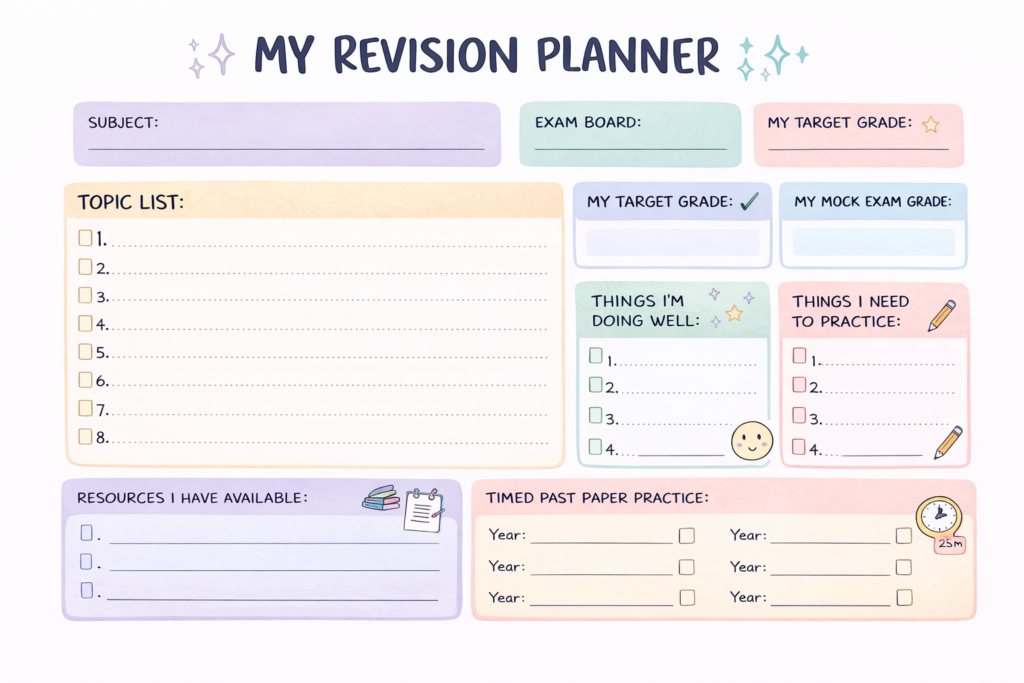
If you want a simple way to get started, my printable GCSE revision planning sheet can really help.
Use it to:
- plan subjects across the week
- organise revision blocks for a day Pomodoro style
- Review your subjects and topics
- Plan individual sessions with a strategic focus.
The Reality (And Why It Matters)
These few weeks genuinely matter.
It could be the difference between grades, there’s not May marks between the top grades, it’s usually in the detailed responses to questions.
Or it could be the difference between a 3 and a 4, those extra revision hours could be worth banking now to avoid having to do resits later on.
I’ve seen both.
The students who start early and use past papers properly are always more confident.
The ones who leave it until exams begin are always the most stressed.
This doesn’t need to be perfect.
It just needs to be structured, focused and realistic
A bit of structure now makes everything easier later.
And when summer comes, they can actually enjoy it knowing they’ve done the work.
Last Updated on Wednesday, April 1, 2026 by Lavania Oluban